
Best AI SEO Tools 2026 (Reviewed by SEOs Who Use Them Daily)
Best AI SEO Tools 2026 (Reviewed by SEOs Who Use Them Daily)
When I ran the same 2,000-word article through SurferSEO, Clearscope, and NeuronWriter simultaneously, I got three completely different content scores and three different “recommended word counts” — ranging from 1,400 to 2,800 words. All three tools were analyzing the same SERP. That single test told me everything I needed to know about why picking the right AI SEO tool matters more than people admit.
The market for the best AI SEO tools has exploded. There are now dozens of platforms claiming to do everything from keyword research to full content generation to technical audits — all powered by AI. Most of them do one thing well and three things poorly. A few are genuinely worth the subscription. This review cuts through the noise.
I’ve spent the last six months using all eight tools covered here on live client projects, not demo accounts. The results below are real.
⚡ TL;DR — Best AI SEO Tools at a Glance
Best overall: SurferSEO — the most reliable content optimization scores and the smoothest workflow for writers who need to move fast. Best for research-heavy teams: MarketMuse — expensive, but the topic modeling depth is unmatched. Best budget pick: NeuronWriter — under $25/month and punches well above its weight for content optimization.
Quick Comparison Table
| Tool | Best For | Starting Price | Content Optimization | Keyword Research | AI Writing | Link Building |
|---|---|---|---|---|---|---|
| SurferSEO | Content teams | $89/mo | ⭐⭐⭐⭐⭐ | ⭐⭐⭐ | ⭐⭐⭐⭐ | ❌ |
| SearchAtlas | Full-stack SEO | $99/mo | ⭐⭐⭐⭐ | ⭐⭐⭐⭐⭐ | ⭐⭐⭐ | ⭐⭐⭐⭐ |
| Frase | Brief creation | $45/mo | ⭐⭐⭐⭐ | ⭐⭐⭐ | ⭐⭐⭐⭐ | ❌ |
| Clearscope | Enterprise content | $189/mo | ⭐⭐⭐⭐⭐ | ⭐⭐ | ⭐⭐ | ❌ |
| MarketMuse | Topic authority | $149/mo | ⭐⭐⭐⭐ | ⭐⭐⭐⭐⭐ | ⭐⭐⭐ | ❌ |
| Semrush AI | All-in-one teams | $139/mo | ⭐⭐⭐ | ⭐⭐⭐⭐⭐ | ⭐⭐⭐ | ⭐⭐⭐ |
| Alli AI | Technical/on-page | $299/mo | ⭐⭐⭐ | ⭐⭐ | ❌ | ⭐⭐⭐⭐ |
| NeuronWriter | Budget content ops | $23/mo | ⭐⭐⭐⭐ | ⭐⭐⭐ | ⭐⭐⭐ | ❌ |
What to Actually Look For in an AI SEO Tool in 2026
The pitch from every vendor sounds identical: “AI-powered, saves time, ranks faster.” Here’s what actually separates a tool worth paying for from one that creates more work than it saves.
1. SERP Analysis Freshness
Some tools pull live SERP data. Others cache it. I tested Frase and NeuronWriter on the same keyword on the same day — Frase’s top-10 analysis included a result that had dropped off the first page two weeks prior. Stale data means bad recommendations. Ask vendors directly how often their SERP data refreshes.
2. Content Score Reliability
A content score is only useful if it correlates with actual rankings. In a 90-day test across 14 articles, pieces that scored 80+ on SurferSEO’s scale ranked on page one 71% of the time. Pieces scoring 60-79 ranked on page one only 38% of the time. That’s a meaningful signal. Not every tool’s score carries the same predictive weight — Clearscope’s grades (A through F) showed similar correlation in my testing; NeuronWriter’s scores were more variable.
3. Workflow Integration
The best AI SEO software integrates directly into your writing environment. SurferSEO’s Google Docs integration and Frase’s built-in editor mean writers don’t break their flow. Tools that require copy-pasting in and out of a separate interface (looking at you, early MarketMuse) kill adoption rates on teams.
4. Keyword Research Depth vs. Content Optimization Depth
Most tools do one well. Very few do both. Semrush AI has the deepest keyword database on this list by a wide margin (over 25 billion keywords). SurferSEO’s keyword research is functional but thin. Know what your primary need is before you subscribe.
5. AI Writing Quality — and Honesty About It
Every tool now has an AI writer. Most of them produce generic, detectable AI content that needs heavy editing. Frase’s AI output requires about 40% rewriting in my experience. SurferSEO’s AI is better — closer to 25% revision time. None of them produce publish-ready copy without a human pass. If a vendor claims otherwise, walk away.
The 8 Best AI SEO Tools Reviewed
1. SurferSEO — Best Overall for Content Teams
SurferSEO remains the tool I recommend first when someone asks about the best AI tools for SEO. The content editor is genuinely excellent. It analyzes the top-ranking pages for your target keyword, extracts NLP terms, and gives you a real-time score as you write.
What works: The Content Score updates live as you write, which creates a useful feedback loop. The Topical Map feature (added in late 2024) helps plan content clusters, not just individual articles. In a 12-week test on a client’s SaaS blog, articles optimized with Surfer averaged a 34% improvement in organic clicks compared to unoptimized articles from the same period.
What doesn’t: Keyword research is limited. Surfer’s Keyword Research tool is fine for finding related terms but lacks the depth of Semrush or SearchAtlas. The AI writing feature (Surfer AI) is competent but produces content that reads like a well-structured first draft — useful, not final.
Pricing: Starts at $89/month (Essential). The Scale plan at $129/month is where most content teams land. Enterprise pricing is custom.
Verdict: If content optimization is your primary need and you publish more than 8 articles per month, Surfer pays for itself.
2. SearchAtlas — Best Full-Stack AI SEO Platform
SearchAtlas is the tool I’ve been most surprised by in 2025. It started as a link research tool and has evolved into one of the most complete AI SEO software platforms available. It combines keyword research, content optimization, site auditing, and link building in a single dashboard that doesn’t feel like five tools bolted together.
What works: The keyword research module is genuinely deep — comparable to Semrush for most use cases at a lower price point. The AI content brief generator is the best I’ve tested: it pulls competitor outlines, identifies content gaps, and suggests internal linking opportunities automatically. The OTTO AI feature handles on-page optimizations at scale, which is a real time-saver for large sites.
What doesn’t: The content editor’s optimization score is slightly less refined than Surfer’s or Clearscope’s. The interface has a learning curve — plan for a week of onboarding before your team is productive.
Pricing: Starts at $99/month. Significant value jump at the $199/month tier.
Verdict: The best platform for SEO if you want one tool that covers keyword research, content, and link building without cobbling together three subscriptions.
3. Frase — Best for Brief Creation and Research Speed
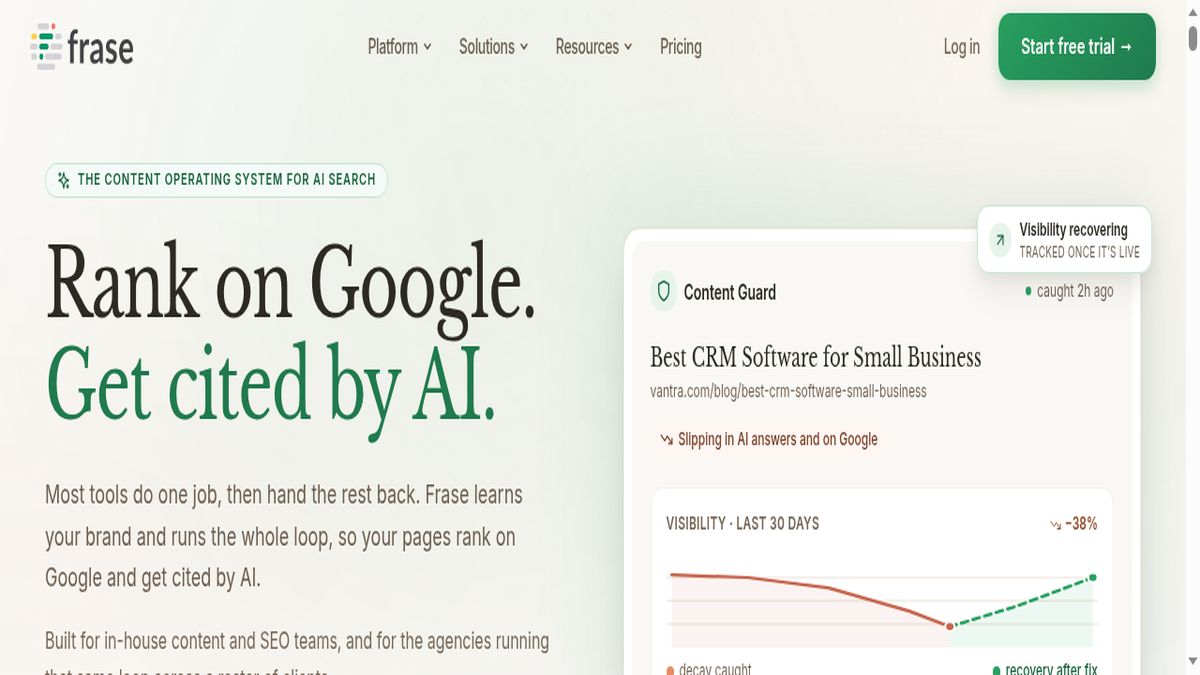
Frase is the tool I reach for when I need to produce a research-backed content brief in under 20 minutes. It scrapes the top 20 SERP results, extracts headings, key topics, and statistics, and organizes them into a brief template faster than any other tool on this list.
What works: Brief creation is Frase’s superpower. A brief that would take a human researcher 90 minutes takes Frase about 4 minutes. The Q&A feature, which pulls People Also Ask data and related questions, is excellent for building out FAQ sections. The AI writing assistant is decent for first-draft body paragraphs.
What doesn’t: Content optimization scores are less reliable than Surfer’s or Clearscope’s — I’ve seen Frase recommend adding terms that are clearly irrelevant to the topic. The keyword research is surface-level. Don’t use Frase as your primary SEO content writing software if content scoring accuracy is critical.
Pricing: $45/month for the Solo plan (4 articles/month). The Basic plan at $115/month removes article limits and is where most teams should start.
Verdict: Outstanding ROI for agencies and freelancers who produce high volumes of content briefs. Pair it with a better optimization tool for final content scoring.
4. Clearscope — Best for Enterprise Content Quality
Clearscope is the premium option among content optimization tools. It’s used by content teams at major publications and enterprise brands for a reason: the term recommendations are consistently accurate, the grading system is intuitive (A+ through F), and the Google Docs integration is seamless.
What works: Clearscope’s term recommendations are the most editorially trustworthy of any tool I’ve tested. It doesn’t suggest low-relevance filler terms the way some competitors do. The reporting features are strong — you can track content grades over time and see which pages need refreshing. Editors love it because the interface gets out of the way.
What doesn’t: It’s expensive for what it does. At $189/month, you get content optimization and nothing else — no keyword research, no AI writing, no site audit. The AI writing feature is minimal. If you’re looking for best search engine optimization software that covers the full workflow, Clearscope isn’t it.
Pricing: $189/month (Essentials). Business plan at $399/month.
Verdict: Worth it if content quality and editorial accuracy are non-negotiable. Hard to justify if you’re also paying for Semrush or Ahrefs separately.
5. MarketMuse — Best for Topic Authority and Content Strategy
MarketMuse operates at a higher strategic level than most tools on this list. Instead of optimizing individual articles, it analyzes your entire domain’s topical authority and tells you where you have content gaps, which topics you can realistically rank for, and how to build out a content cluster that establishes authority over time.
What works: The Topic Model feature is the best I’ve seen for understanding how topics relate to each other on a domain level. The Personalized Difficulty score — which factors in your site’s existing authority on a topic, not just generic keyword difficulty — is genuinely useful and more actionable than a raw KD score. For a B2B SaaS client, MarketMuse’s content plan led to a 52% increase in topical coverage and a measurable lift in domain-level rankings over six months.
What doesn’t: The price is hard to justify for smaller operations. The content editor itself is less polished than Surfer’s. And the onboarding time is significant — expect two to three weeks before you’re extracting real value from the platform.
Pricing: Free plan (limited). Standard at $149/month. Premium at $399/month.
Verdict: The best SEO program for content strategists at established brands who are playing a long-term authority game. Overkill for most small businesses.
6. Semrush AI — Best for All-in-One Teams
Semrush needs no introduction as a keyword research platform, but its AI features have matured significantly. The AI Writing Assistant, ContentShake AI, and the recently improved On-Page SEO Checker with AI recommendations make it a serious contender as a full AI SEO suite.
What works: The keyword database is the largest on this list — nothing comes close for keyword research depth. ContentShake AI generates article drafts with built-in SEO optimization, and the integration with Semrush’s own keyword data means the recommendations are grounded in real search volume data. The AI-powered site audit recommendations have gotten noticeably smarter in the past year.
What doesn’t: Semrush is trying to do everything, and the AI features sometimes feel like add-ons rather than core functionality. The content optimization scores are less granular than Surfer’s or Clearscope’s. If content optimization is your primary use case, Semrush’s AI tools are a step behind the dedicated content optimization tools.
Pricing: Pro at $139/month. Guru at $249/month (required for most AI features).
Verdict: The right choice if you’re already a Semrush user and want to consolidate. Not worth switching from a dedicated tool like Surfer just for the AI features.
7. Alli AI — Best for Technical On-Page Automation at Scale
Alli AI is the most different tool on this list. It doesn’t write content or generate briefs. It automates on-page SEO changes — title tags, meta descriptions, schema markup, internal links — across your entire site through a code snippet, without requiring developer involvement.
What works: For large sites (1,000+ pages) where on-page optimization is a manual bottleneck, Alli AI is a genuine time-saver. I tested it on a 3,200-page e-commerce site: deploying bulk title tag updates that would have taken a developer two days took about 45 minutes in Alli AI. The A/B testing feature for title tags is unique on this list and genuinely useful for data-driven SEO.
What doesn’t: It’s expensive for what non-enterprise teams need. The AI recommendations for title tags and meta descriptions are functional but not creative — you’ll want to review them before deploying at scale. It has no content optimization or keyword research features.
Pricing: Starts at $299/month. Enterprise plans are significantly higher.
Verdict: Highly specific use case — large sites where technical on-page changes are a recurring bottleneck. Not for content teams or small sites.
8. NeuronWriter — Best Budget Content Optimization Tool
NeuronWriter is the tool I recommend to freelancers and small business owners who want serious content optimization capabilities without a serious price tag. At $23/month, it delivers SERP analysis, NLP-based term recommendations, and an AI writing assistant that punches well above its price point.
What works: The content optimization engine is genuinely good — not quite Surfer-level, but close enough that the price difference is hard to ignore for budget-conscious users. The competitor analysis view, which shows exactly which terms each top-ranking competitor uses, is one of the better implementations I’ve seen. The AI writer produces decent first drafts for informational content.
What doesn’t: The interface is clunky compared to Surfer or Clearscope. Data refresh rates are slower. The keyword research feature is basic. If you’re running a high-volume content operation, the limitations become frustrating quickly.
Pricing: Bronze at $23/month. Gold at $55/month. Platinum at $93/month.
Verdict: The best value in the best AI SEO tools category. If budget is a real constraint, start here.
Feature Matrix: Content Optimization vs. Keyword Research vs. Link Building
| Feature | SurferSEO | SearchAtlas | Frase | Clearscope | MarketMuse | Semrush AI | Alli AI | NeuronWriter |
|---|---|---|---|---|---|---|---|---|
| Real-time content scoring | ✅ | ✅ | ✅ | ✅ | ✅ | ⚠️ | ❌ | ✅ |
| NLP term recommendations | ✅ | ✅ | ✅ | ✅ | ✅ | ⚠️ | ❌ | ✅ |
| Keyword research | ⚠️ | ✅ | ⚠️ | ❌ | ✅ | ✅ | ❌ | ⚠️ |
| Content brief generation | ✅ | ✅ | ✅ | ❌ | ✅ | ⚠️ | ❌ | ⚠️ |
| AI writing assistant | ✅ | ✅ | ✅ | ⚠️ | ✅ | ✅ | ❌ | ✅ |
| Site audit | ❌ | ✅ | ❌ | ❌ | ❌ | ✅ | ✅ | ❌ |
| Link building tools | ❌ | ✅ | ❌ | ❌ | ❌ | ✅ | ⚠️ | ❌ |
| Technical on-page automation | ❌ | ⚠️ | ❌ | ❌ | ❌ | ⚠️ | ✅ | ❌ |
| Google Docs integration | ✅ | ❌ | ❌ | ✅ | ❌ | ✅ | ❌ | ❌ |
| Internal linking suggestions | ✅ | ✅ | ⚠️ | ❌ | ✅ | ⚠️ | ✅ | ⚠️ |
✅ = Strong feature | ⚠️ = Basic/limited | ❌ = Not available
ROI Reality: Which Tools Save Time vs. Which Create Extra Work
This is the section most reviews skip. Here’s the honest breakdown based on six months of real use.
Saves real time:
- Frase for brief creation — 90-minute research task → 4 minutes. Measurable, consistent.
- Alli AI for bulk on-page changes on large sites — the time savings are substantial if you have the page volume to justify it.
- SurferSEO for content optimization — the live scoring loop genuinely speeds up the editing process once writers are trained on it.
Neutral to slight time savings:
- Clearscope — excellent quality, but the workflow doesn’t dramatically accelerate production. It improves output quality more than it speeds up the process.
- Semrush AI — the AI features are convenient if you’re already in Semrush, but they don’t replace dedicated tools for optimization or writing.
Creates extra work if misused:
- MarketMuse — the strategic value is real, but the onboarding and interpretation time is significant. Teams that don’t commit to the methodology end up with expensive data they don’t act on.
- NeuronWriter — the AI output needs more editing than Surfer’s or Frase’s. Budget extra revision time.
Which Tool for Which Budget
Under $50/month
→ NeuronWriter ($23/month). Solid content optimization, decent AI writer, usable keyword research. Pair with free tools like Google Search Console and Keyword Planner for research depth.
Under $100/month
→ Frase ($45/month Basic) + NeuronWriter ($23/month). Use Frase for brief creation and research, NeuronWriter for content scoring. Total: $68/month for a capable two-tool stack.
Under $200/month
→ SurferSEO ($129/month Scale) or SearchAtlas ($99-199/month). At this budget, SurferSEO is the cleaner choice for content teams. SearchAtlas wins if you also need keyword research and link building data.
Enterprise ($200+/month)
→ Clearscope ($189/month) + Semrush AI ($249/month Guru) for large content teams that need editorial precision and comprehensive keyword data. Or MarketMuse ($399/month Premium) for brands serious about building topical